

 Facebook
 X
X
 Pinterest
 Copy Link
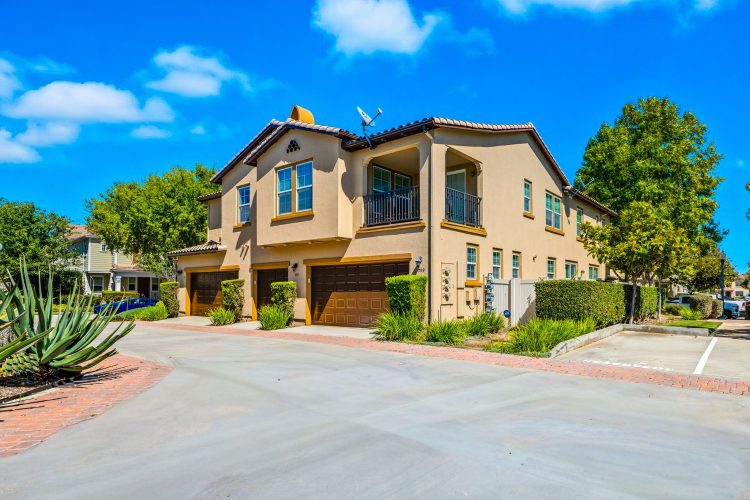
Higher mortgage rates, fewer buyers, and longer selling times are changing the conversation for Irvine homeowners. But the impact isn’t the same for every type of property.
If you’re considering selling your Irvine home this fall, you may be hearing two very different stories about the housing market.
One says home prices are holding up because inventory remains relatively low. The other says homes are sitting longer, buyers are negotiating harder, and sellers are reducing their asking prices.
Both can be true.
The latest Orange County Housing Report, published September 28, 2026, shows a market that has slowed considerably. And while the numbers don’t suggest another housing crash, they do point to a change in how sellers need to approach pricing, preparation, and expectations.
The Bigger Problem Isn’t More Homes. It’s Fewer Buyers.
Orange County currently has 4,952 homes available for sale. That’s only 13 more than two weeks earlier and still well below the inventory levels we routinely saw before the pandemic.
Under normal circumstances, limited inventory would help support home prices.
But there’s another side to the equation.
Buyer demand, measured by the number of new pending sales over the previous month, has fallen to 1,349. That’s the lowest September reading since 2007.
The primary driver is mortgage rates.
According to the report, the average 30-year fixed mortgage rate climbed from approximately 6% in February to 7.5% by late September, with a particularly sharp increase during the final four weeks.
For a buyer financing $800,000, the difference between 6% and 7.5% is approximately $780 more per month in principal and interest.
That’s a significant change in purchasing power, especially in a market like Irvine, where home prices already stretch many household budgets.
Some buyers can no longer qualify for the homes they were considering. Others are choosing to wait, reduce their budgets, or become more selective.
The result is fewer buyers competing for essentially the same number of homes.
And that changes the negotiating environment.
The chart below illustrates the problem. Orange County’s available inventory has remained relatively steady in recent weeks, while pending sales have declined. That imbalance is creating more competition among sellers.
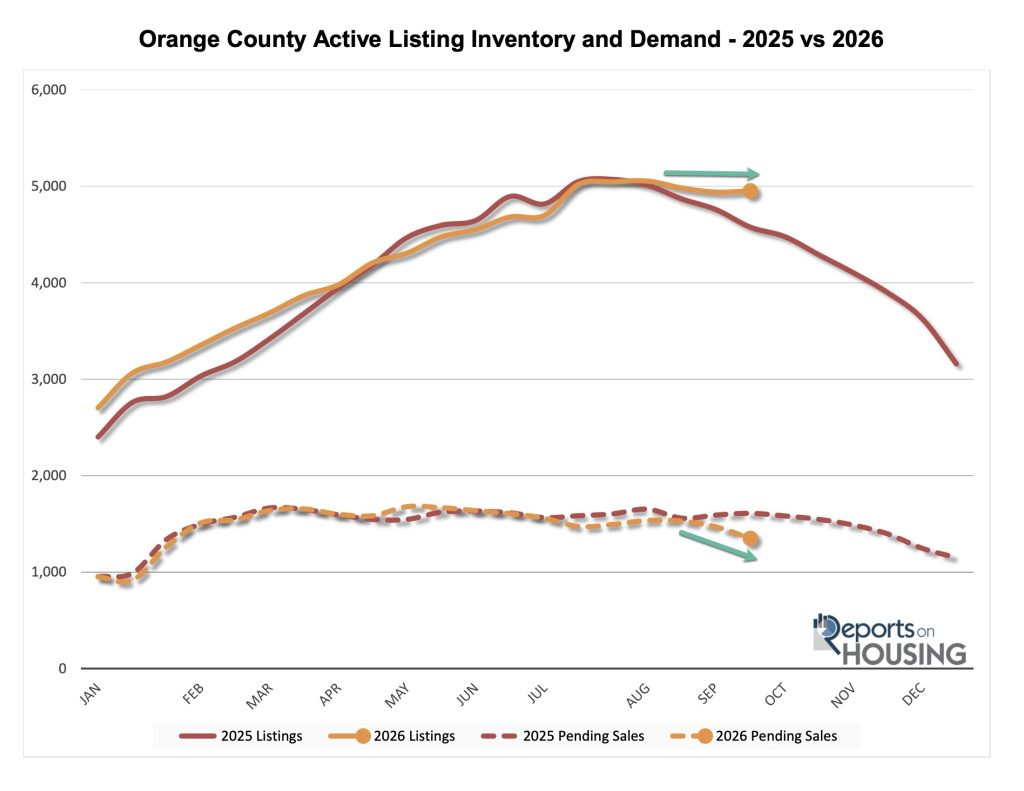
Orange County inventory has remained relatively stable while buyer demand has weakened. Source: Reports on Housing, September 28, 2026.
As I discussed in Is Now a Good Time to Buy a Home in Irvine, CA?, higher mortgage rates create affordability challenges, but reduced competition can also give qualified buyers more room to negotiate.
Homes Are Taking Longer to Sell, Especially Condos
One of the most revealing statistics in the report is Expected Market Time.
This measures how long it would take to sell the current inventory at the existing pace of pending sales. It’s not the same as the actual days on market for an individual property, but it gives us a useful indication of the balance between buyers and sellers.
Across Orange County, Expected Market Time has increased to 110 days, compared with 85 days a year ago.
However, there’s an important difference when we separate attached and detached housing.
| Property type | Expected Market Time |
|---|---|
| Condos and townhomes | 128 days |
| Detached single-family homes | 99 days |
| Orange County overall | 110 days |
Source: Reports on Housing, September 28, 2026.
That’s nearly a month of additional market time for attached homes compared with detached properties.
The difference becomes even clearer when looking at the historical trend. Attached and detached homes haven’t always been this far apart, but the gap has widened considerably in 2026.
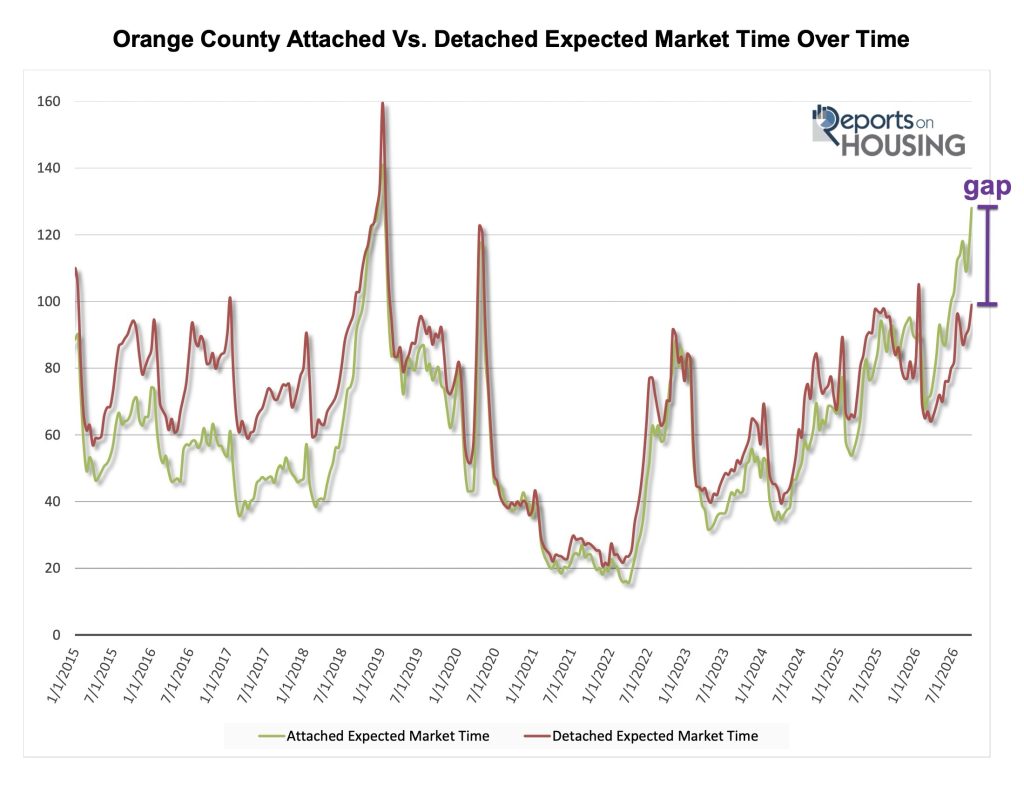
Attached homes have a longer expected market time than detached homes in Orange County. Source: Reports on Housing, September 28, 2026.
Why Irvine Condo Sellers May Face More Competition
Irvine has a substantial number of condominiums and townhomes, including properties throughout Woodbridge, Northwood, Westpark, Oak Creek, and other communities.
Many of these homes appeal to first-time buyers and others who are particularly sensitive to monthly ownership costs.
A buyer comparing two properties isn’t looking only at the purchase price. They’re also considering mortgage payments, property taxes, HOA dues, insurance, and any Mello-Roos or other special assessments.
When mortgage rates rise, those additional costs become more important.
Consider an Irvine condominium with a relatively affordable asking price but several hundred dollars in monthly HOA dues. A competing property might cost more upfront but have lower recurring expenses.
The buyer needs to evaluate the total cost of ownership, not just the price.
That doesn’t mean condos aren’t selling. It means buyers have more reasons to compare properties carefully, and sellers may have less flexibility in how their homes compete.
Condition matters, too. A home that needs substantial updates may be competing against another property that is move-in ready. With fewer buyers actively shopping, those differences can become more significant.
This difference isn’t entirely new. Earlier this summer, I examined how Orange County and Irvine buyers were gaining more negotiating room, particularly when comparing attached homes with detached properties. The latest numbers suggest that gap has widened.
Detached Homes Have an Advantage, but They’re Not Immune
Detached single-family homes are moving faster across Orange County, according to the report.
One possible explanation is that detached homes often attract a different segment of the market, including move-up buyers who may have substantial equity from an existing home and greater purchasing power. For these buyers, a few hundred dollars in additional monthly payments may have less impact on affordability than it would for a first-time buyer working with a tighter budget.
Detached homes may also have less direct competition within certain Irvine neighborhoods where available inventory remains limited.
However, a 99-day Expected Market Time is hardly a fast-moving market.
Sellers of detached properties still need to pay attention to competing listings, condition, location, and pricing.
The luxury market deserves particular attention. Across Orange County, homes priced above $2.5 million now have an Expected Market Time of 184 days, up from 157 days just two weeks earlier.
The higher the price point, the smaller the potential buyer pool may become. Even a well-presented home can require patience.
Does This Mean Irvine Home Prices Are Going to Fall?
Not necessarily, although some downward pressure is already evident in the broader market.
According to the report, Orange County home values remain approximately 2.8% higher than a year ago, based on the Zillow Home Value Index.
At the same time, weakening demand has shifted negotiating conditions toward buyers.
This is where sellers need to distinguish between home values and asking prices.
A home’s market value doesn’t automatically decline because a neighboring property reduces its asking price. But when comparable homes consistently sit unsold or sell below their original asking prices, those transactions can influence what buyers are willing to pay.
It’s also important to recognize that Orange County statistics don’t necessarily describe every Irvine neighborhood, price range, or property type.
A detached home in an established neighborhood with little competing inventory may perform very differently from an attached condominium where buyers have several similar options.
That’s why a current, property-specific analysis is more useful than applying a countywide price trend to an individual home. An instant home-value estimate can provide a starting point, but it should be evaluated alongside recent comparable sales, competing listings, and current buyer activity.
Is This Another 2008 Housing Market?
The short answer is that today’s market has some very important differences.
The Orange County Housing Report explains that the years leading up to the Great Recession were characterized by excessive inventory, weaker lending standards, and widespread financial distress.
Today’s homeowners generally have more equity, and distressed sales remain extremely limited.
In fact, only 13 foreclosures and short sales were actively listed across Orange County at the time of the report.
That doesn’t mean prices cannot decline. They can, and they have during previous market adjustments.
But a market with fewer buyers is not automatically a market headed for a housing collapse.
For sellers, the more immediate concern isn’t a repeat of 2008. It’s the possibility of spending months on the market while competing properties adjust their prices.
What Should Irvine Homeowners Do If They Want to Sell This Fall?
The biggest mistake sellers can make in a slowing market is pricing their home based entirely on what a similar property sold for several months ago.
Those sales are important, but they occurred under different market conditions.
A home that attracted multiple offers when mortgage rates were closer to 6% might face a much smaller audience with rates around 7.5%.
Here’s how I would approach a fall sale:
Price against today’s competition. Recent closed sales establish important benchmarks, but active listings, pending sales, price reductions, and expired listings help reveal what is happening right now.
Understand your buyer’s total monthly cost. This is especially important for attached homes with HOA dues, Mello-Roos, or other recurring expenses.
Prepare the property to compete. When buyers have more choices and less purchasing power, deferred maintenance and outdated finishes can become bigger obstacles.
Pay attention to early market feedback. If a home is generating online views but few showings, or showings without offers, that information deserves attention. Sometimes the problem is presentation. Often, it’s the relationship between condition and price.
Decide whether selling this fall serves your actual goals. Some homeowners have flexibility, while others are relocating, purchasing another property, or making a lifestyle change. The right decision depends on the circumstances, not a prediction about where interest rates might go next. For homeowners planning to purchase another property, understanding their equity and purchasing power is especially important. I covered this in Before You Buy Your Next Orange County Home, Know These Two Numbers.
The Bottom Line for Irvine Sellers
The Orange County housing market is not collapsing, but it is changing.
Higher mortgage rates have reduced the number of active buyers. Homes are taking longer to sell, and the difference between attached and detached properties has become increasingly important.
For Irvine homeowners, that means there is no longer one simple answer to whether it’s a good time to sell.
A well-priced detached home with limited competition may still attract strong interest. A condominium competing against several similar listings may require a more aggressive pricing strategy.
Neither situation means a seller has to give their home away.
It does mean understanding today’s market rather than trying to recreate yesterday’s.
If you’re considering selling your Irvine home this fall, I can help you evaluate recent sales, current competition, buyer activity, and the pricing strategy that makes sense for your particular property. You can also learn more about my approach to selling your home, including pricing, preparation, and marketing.
Market data source: Steven Thomas, Reports on Housing, Orange County Housing Report, September 28, 2026. Countywide statistics and trends may not reflect conditions for individual Irvine properties.


